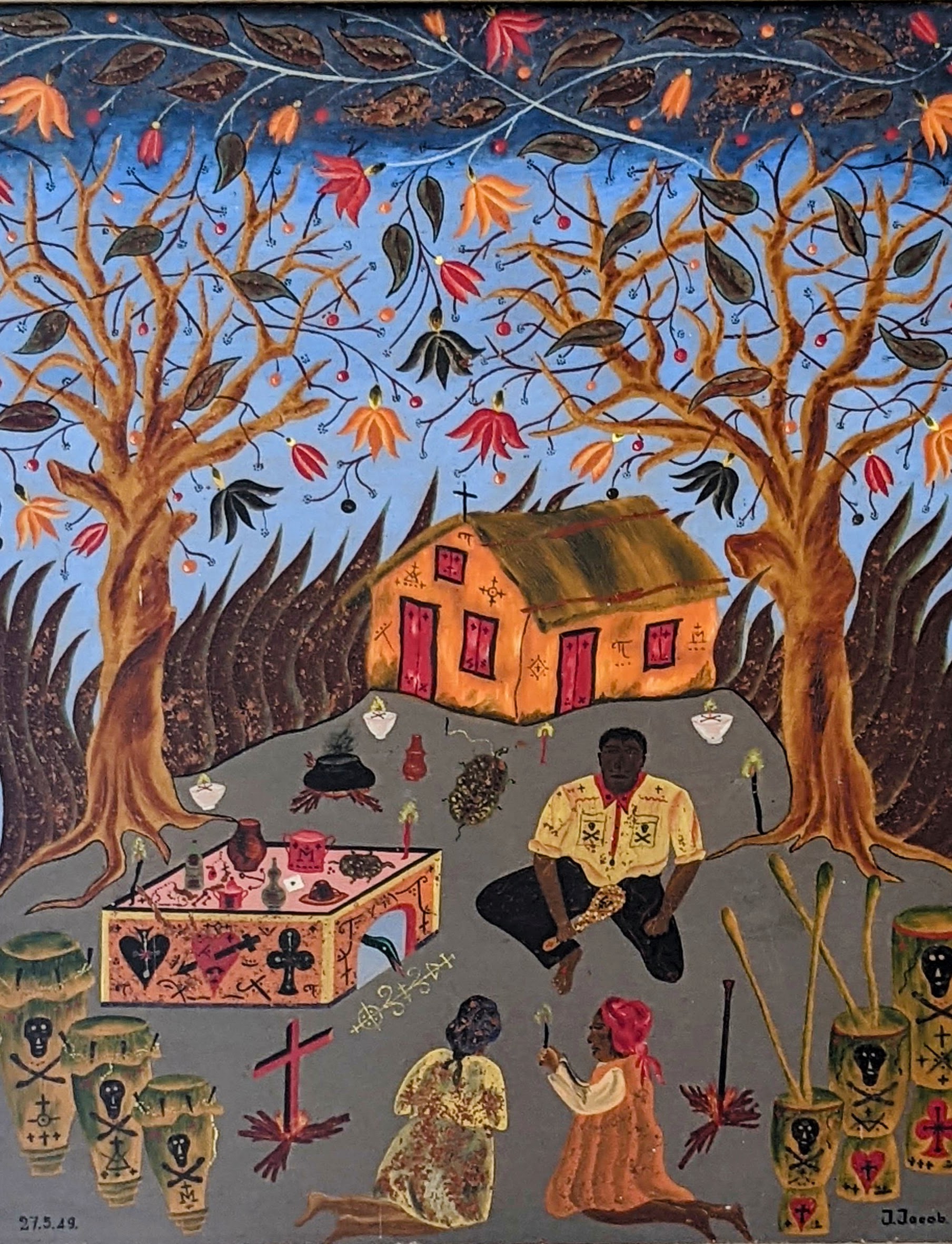
I grew up in a house filled with paintings. My favorites were the Haitian ones , colorful folk paintings that described a place that was like a fantasy, a tropical mountainside temples, vodou ceremonies amid oddly shaped trees. That fascination grew into my first visit to Haiti in 1982 or so. when I had the opportunity to travel to the island as part of a photo project where 100 or so photographers were given the opportunity to capture a unique moment in one day. My first impression of Port au Prince was that I had never seen so many people hustling around in the most difficult circumstances possible. I stayed in the old Holiday Inn downtown, and when I emerged with my cameras I was quickly approached by a young man offering to be my guide. This was in the days of Baby Doc, now regarded as the golden days of Haiti, but nothing happened in Port au Prince without the government knowing about it. Including my visit. In 1982 the world was gripped by the AIDS crisis, and Haiti was mistakenly accused of being the source of the deadly disease, it was against the backdrop of all of this that I spent three days driving around Port au Prince with my handler/guide, and I took a few images included in this larger retrospective. I got a call from Time Inc to shoot a story on Jean Bertrand Aristede in 1991 and I stayed at the infamous Holiday Inn. It had a pool at the center of the courtyard and Aristede was impossible to work with. He didnt return my calls, and I spent too much time at the pool. Enough time to meet a blonde Brazilian bombshell getting a divorce from her powerful husband, this quickly led to an affair and the end of my trip to Haiti. I packed up and split, broke off the affair and my marriage and went back to Manhattan. The magazine wasn’t having any of it and sent me back agian, ony this time the Brazilian was not there but Aristede was available, but barely. He wasnt cooperative and I was as pushy as I could be, which really wasn’t nearly enough. I ended up moving to New Orleans, experienced Hurricane Katrina there, and began a relationship with a reporter from New York, who had some magazine connections that led to another trip to Haiti after a series of hurricanes and tropical storms brought a torrent of mud down on the city of Gonaives. I picked up an assignment from Doctors Without Borders and we flew to Port au Prince and stayed at the doomed Hotel Montana, and hired a driver to go to Gonaives, which was digging itself out of the mud. After Katrina disaster journalism seemed to come naturally to me, and although I had never looked for that kind of hard news subject matter, I was not uncomfortable around the suffering and violence that goes with this kind of work. Returning from Gonaives we passd a mob dragging a thief behind a car, before stopping to beat him (he was already dead) and burn the body. I instinctively stopped the car and jumped out to photograph all of it. More and more pictures did not repair whatever part of me was already dehumanized by what I had experienced in New Orleans after Katrina, horrific images of bloated bodies in the street.
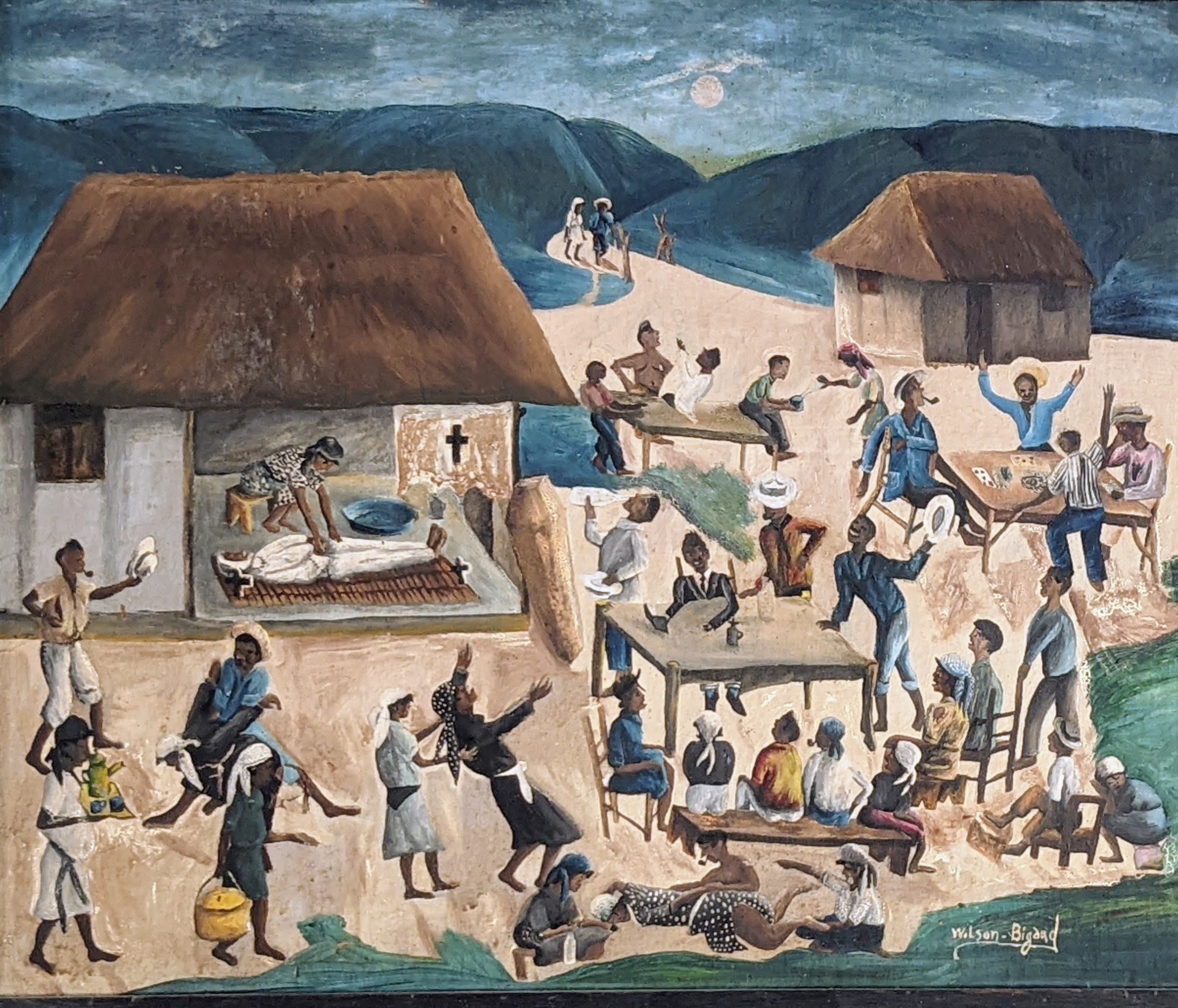
Its fascinating that many of the tableaus in Wilson Bigaud’s painting (top right) are repeated in the photographs that I took 50 years later, at bottom right, the woman thrashing on the floor, is depicted in one of my images from Gede, the figure falling back into the arms of the priestess dressed in white, is similar to the cover photograph of a mourner in Gonaives aftyer a funeral, the figure dressed in white like a corpse in the peristyle of the painting you will find in the Gede ceremony in Port au Prince. The beautiful mountains on the road to Jacmael are in the distance of Bigaud’s painting as well.
Thiis really is the dichotemy of the Westerner in Haiti, there is so much visual beauty in Haiti, its easy to romanticize and overlook the brutality and sadness of the people, Although most will never go there I think that you can gain a great understand through the work I am sharing here! Thanks for looking.